February 1, 2026: Why you need strength insurance now
Hi friends,
If your only goals are driving to the grocery store, sitting on the couch, and walking to the mailbox, you don't need to be very fit or strong.
But if your future self has bigger plans—traveling, playing with grandkids, living independently—you need to start building capacity now.
Strength in reserve is the gap between what your body can do at maximum effort and what you're doing in daily life. It’s something I think about a lot as a physical therapist when treating patients.
The bigger your reserve, the easier everything feels and the safer you are from injury.
Think of it like a car engine. A Toyota Corolla and a Lamborghini both get you to the grocery store, but only the Lamborghini has power in reserve when you need to accelerate quickly.
Why Most People Don't Have Enough Reserve
After age 30, you lose 3-5% of your muscle mass per decade. By your 60s and 70s, that loss accelerates. Meanwhile, daily demands stay the same—groceries still weigh 20 pounds, stairs are still stairs.
Eventually, the gap closes. What felt easy becomes hard. What felt hard becomes impossible.
When Capacity Meets Demand, Injuries Happen
Imagine you're 75, carrying 20 pounds of groceries:
Max capacity of 22 pounds = 90% effort. One wrong movement and something gives out.
Max capacity of 50 pounds = 40% effort. Huge buffer zone.
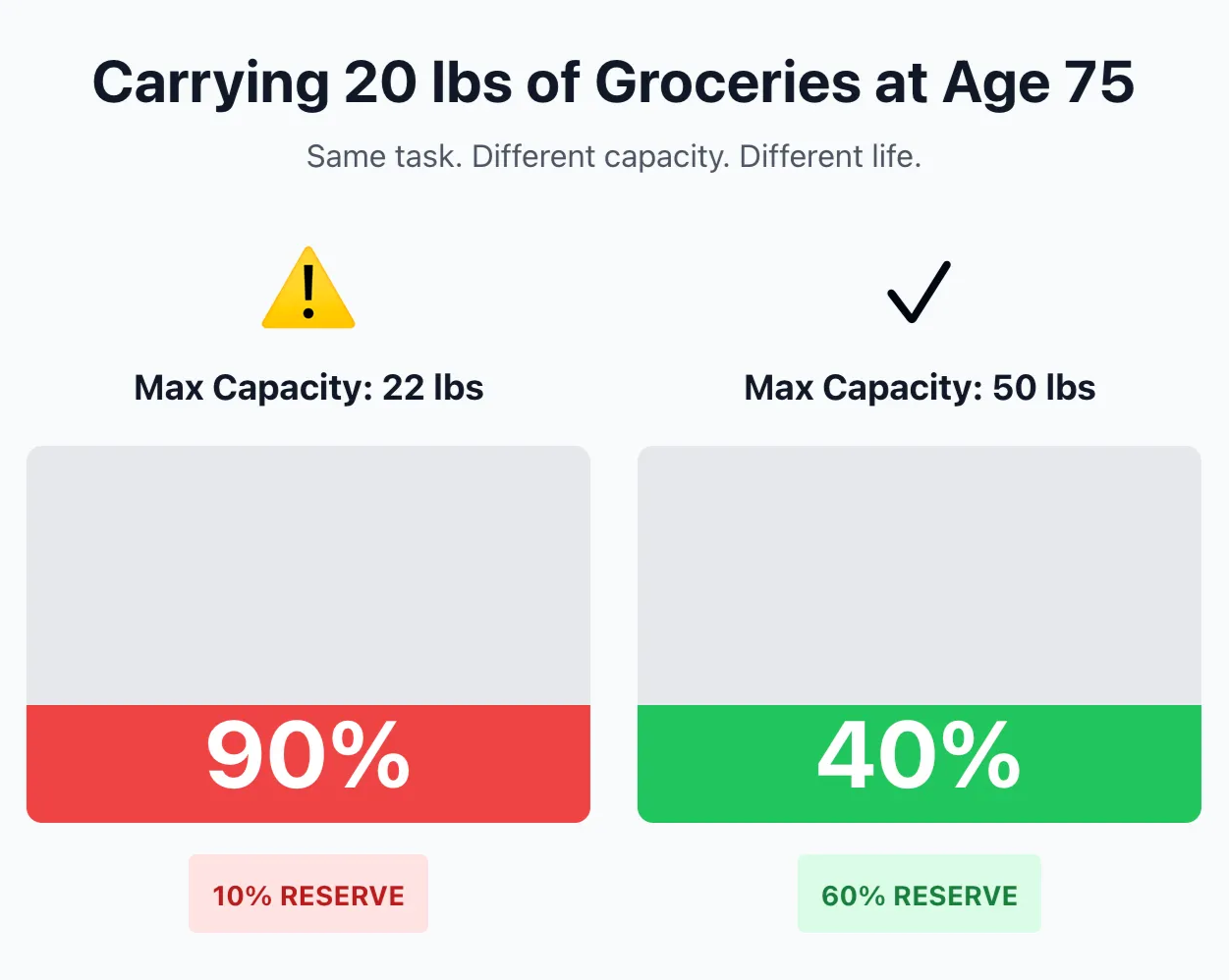
This is strength in reserve.
What you do in your 20s, 30s, and 40s determines what you can do in your 70s and 80s.
Building strength is like investing—the earlier you start, the more it compounds. But people in their 60s, 70s, and 80s can still build significant strength through resistance training.
The goal isn't just surviving, it's thriving. Having the strength to travel, garden, play with grandkids, and maintain independence.
The best time to start building a reserve was 20 years ago. The second-best time is today.
Until next week,
Kevin
✍️ Quote I’m reflecting upon
“The important thing is not what one is born with but what use one makes of that equipment.”