The Best Books I Read in 2025
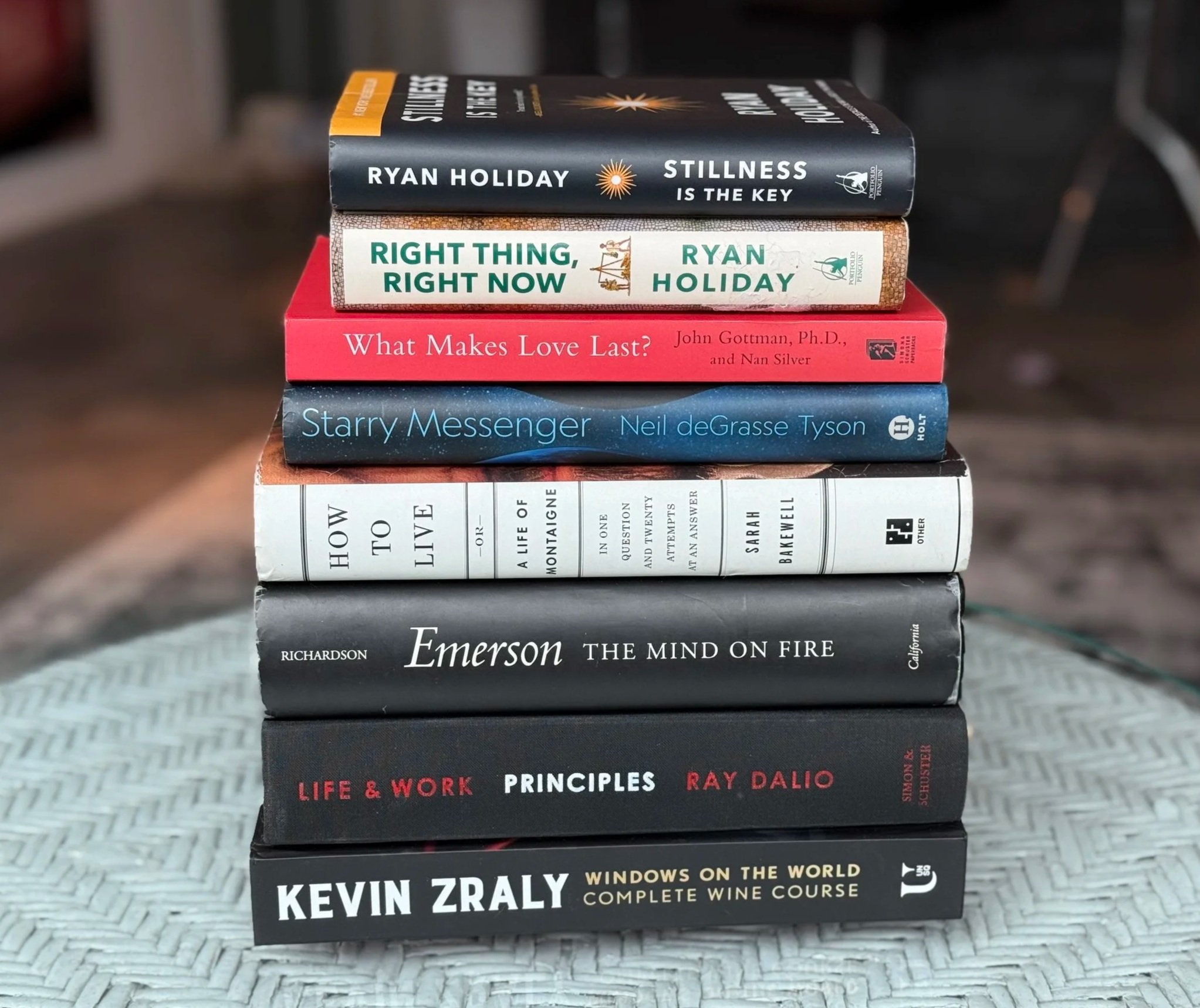
Another year down, but reading is here to stay. It's been a busy one—finishing my fellowship, traveling, and planning an engagement—but I always make time for books. Here are my favorites from this past year.
Stillness is the Key by Ryan Holiday
This is my third time reading this book, and it's still one of my all-time favorites. In a world of constant noise and notifications, we could all benefit from more stillness. This book helped me stop telling myself that once I achieve X or get to Y point in life, then I'll be happy. It taught me that if I want to be fulfilled, I need to appreciate the beauty in the world and life as it is, and seek more moments of stillness. One of my favorite quotes: "We think we need more and don't realize we already have so much."
Right Thing, Right Now by Ryan Holiday
People get degrees debating morality and ethics, but deep down, we all know what the right thing to do is. It doesn't cost much to do the right thing, but it's often not an intrinsic habit. Being kind, honest, and just will take you far in life—and it's the right thing to do.
What Makes Love Last by John Gottman and Nan Silver
I make it a point to read at least one relationship book per year, and they're often the most useful. No one teaches us how to be a good friend, spouse, or colleague—we have to figure it out ourselves. My biggest takeaway from this book is that our friends and spouses are rarely looking for us to solve their problems. What they’re actually looking for is to feel understood, validated, and accepted.
Starry Messenger by Neil deGrasse Tyson
"We are more likely to be swayed by a single person who testifies with passion than by a bar chart containing data compiled from thousands of people." A great book for learning to look at things objectively and question our own beliefs. The world is full of people with strong biases trying to sway us toward their way of thinking. What we need more of are people who can look at problems logically and solve them without personal agendas.
How to Live: Or A Life of Montaigne in One Question and Twenty Attempts at an Answer by Sarah Bakewell
Michel de Montaigne was a prominent philosopher during the French Renaissance. This book is both a biography and a guide to his advice on how to live, die, read, pay attention, and question the world. My favorite quote: "If you don't know how to die, don't worry; Nature will tell you what to do on the spot, fully and adequately. She will do this job perfectly for you; don't bother your head about it."
Emerson: The Mind on Fire by Robert D. Richardson Jr.
I didn't know much about Emerson before this, but it didn't disappoint. The book is dense, but it gives great insight into his life, struggles, and ideas.
Principles by Ray Dalio
A book full of wisdom. I only read the first half on "Life Principles"—the second half on "Work Principles" wasn't as interesting or applicable to me. My takeaways: embrace reality by being open-minded, take responsibility for outcomes rather than complaining about things outside your control, and make better decisions by understanding that people are wired differently.
Windows On The World by Kevin Zraly
A patient gifted me this, and unfortunately for my bank account, it got me interested in wine. This is a great starting point for anyone looking to learn more—from the winemaking process to grape varietals to different wine regions. One of my favorite things Zraly does is recommend great value wines for around $15-20.
The Art Thief by Michael Finkel
This may be my favorite book of the year. It's nonfiction that reads like fiction—the story of how an art thief stole over 200 pieces worth about $2 billion. The psychology of Stéphane Breitwieser is fascinating. He wasn't motivated by money but rather wanted to be surrounded by beauty.
Scientific Principles of Hypertrophy Training by Dr. Mike Israetel
After 30, muscle mass and strength slowly decline. Resistance training can help mitigate this and keep us healthier as we age. This is an excellent guide to building muscle, though it's quite scientific and may be intimidating if you're just getting into lifting. The gist is to work a given muscle 2-4 times per week for sets of 5-30 reps with 0-5 reps in reserve.
Reading is one of the best habits I've picked up (tied with exercise). It's supposed to be fun, so if you're 30 pages into a book and dreading every time you pick it up, grab another one. Life's too short, and there are too many great books out there to slog through something you don't enjoy.
Cheers,
Kevin